





























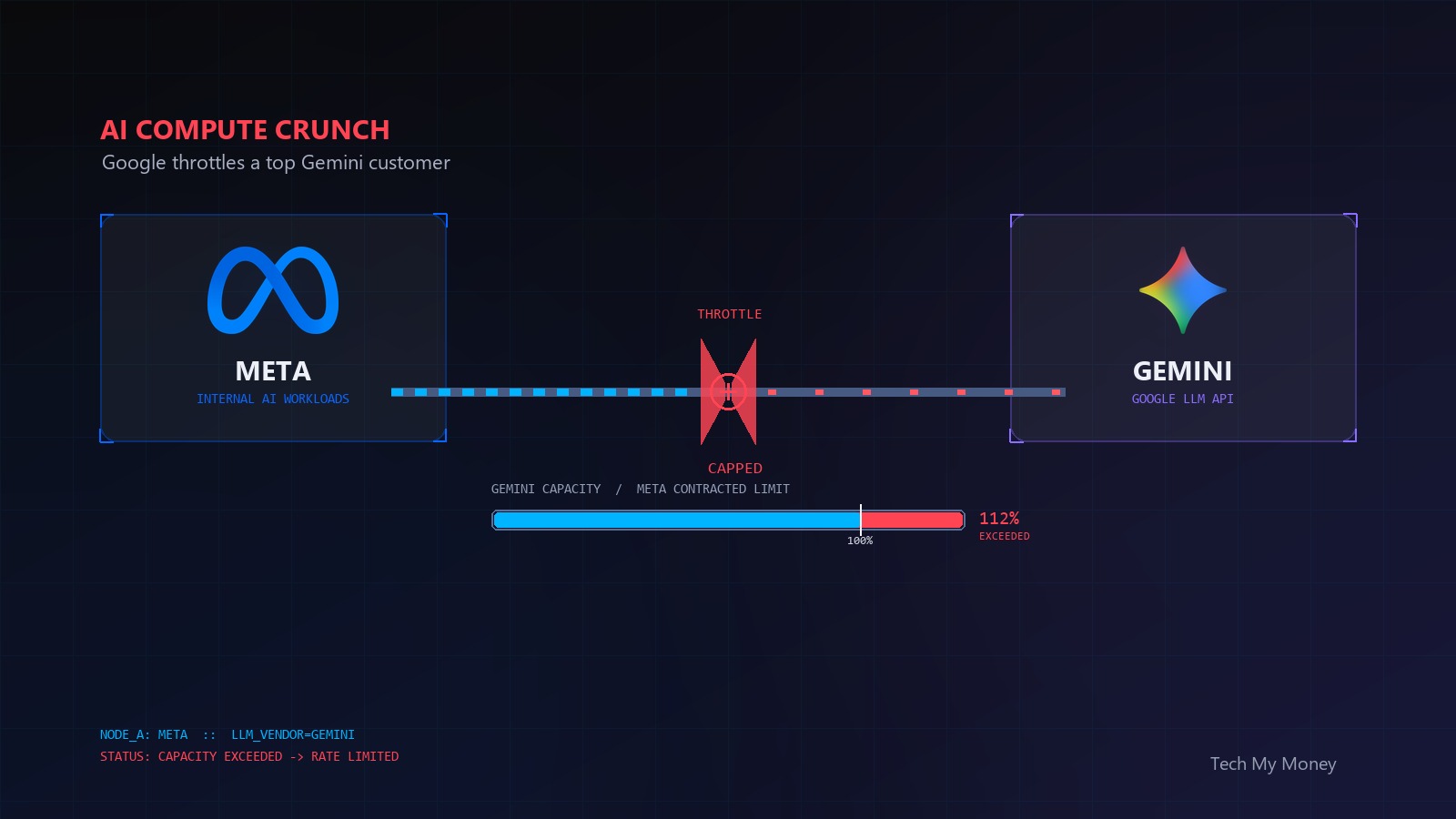
Google Gemini Meta AI access is reportedly being throttled at one of its biggest customers. Google has capped how much of its Gemini AI Meta can use, after the social media company blew past its agreed compute capacity. The squeeze shows how tight AI compute has become, even for giants spending tens of billions on data centers of their own.
People familiar with the matter told the FT that the warning landed in March. Meta uses Gemini AI for customer-service bots, advertiser chatbots, and internal coding assistants. The company also leans on Gemini for content moderation work, including scam detection and harmful content takedowns.
Meta picked Google’s models over its own open-source Llama family because Gemini performed better on those tasks. The company also runs Anthropic’s Claude for similar workloads. None of that helped once the GPU budget ran out.
Even Google is short on GPUs
Meta does not run a public cloud business. Its compute footprint is overwhelmingly its own. The company has guided to capital spending of $115 billion to $145 billion in 2026 alone. That is nearly double its 2025 total, with AI infrastructure at the center.
Google is in the same boat. It recently agreed to pay SpaceX about $920 million a month to use xAI’s data centers. The deal helps handle the extra compute behind Gemini Enterprise. It also highlights a market where every large AI lab is buying and selling capacity at the same time.
For context on how the cost picture has shifted, see our piece on AI compute costs going parabolic and our breakdown of why token prices are surging across the major model providers. Both track the same squeeze.
What Meta is asking staff to do
After Google’s warning, Meta reportedly told employees to use tokens more efficiently. That means fewer prompts, shorter contexts, and tighter workflows. For a company spending well over $100 billion a year to fix this problem, asking staff to ration usage is an uncomfortable early signal.
It tracks with broader reports of large enterprises pulling back on AI spend as bills climb. Token costs have risen so steeply that some companies, including AI vendors themselves, are cutting back.
The bigger picture
AI providers are not yet profitable on the volume they sell. Analysts say revenue is still a small fraction of the underlying compute and energy costs, even for OpenAI. The fact that a hyperscaler like Google had to cap one of its largest AI customers suggests the ceiling is closer than the build-out announcements imply.
For Meta, the immediate fix is rationing. The longer-term fix is the data centers it has not yet finished building. Until those come online, every Gemini AI call is a line item the company cannot fully control. Google’s cap is the first hard reminder.